Design thinking in healthcare can be applied across many dimensions:
Communicating with patients directly, whether through visual, auditory, or multimedia means
Translating complex health information for different audiences
Creating useful and efficient spaces, whether virtual or in-person, in architecture or experiences
Design goals for heart failure
For the heart failure context, specific design goals include:
Designing for education (e.g. definitions, terms, basic health knowledge) Why is this important? The promotion of health literacy has been shown to significantly improve medication adherence and quality of life in heart failure patients
Promoting evidence-based practice (e.g. the inclusion of both robust science and patient voices in the creation of products, architecture, and services that target them) Why is this important? The promotion of informed decision-making is key to create an equitable healthcare system, where patients, caregivers, and families are empowered in their own care
Encouraging systems thinking and collaboration to identify and tackle complex challenges (e.g. gathering relevant stakeholders–clinicians, patients, communicators, strategists–to identify and address systemic issues within the healthcare system, like accessibility of care in remote communities, while recognizing the holistic roles of home, work, and community) Why is this important? Behavioural change has been shown to lead to better outcomes and quality of life, both day-to-day and for longer-term decision-making, for patients experiencing heart failure
How can D4H be used?
Potential context scenarios include:
Reaching out to HF patients for clinical trials
Developing instructional documents for a new medical device for self-management
Engaging with hard-to-reach audiences (e.g. minority populations, remote communities)
Onboarding new designers/communicators in the healthcare space
Knowledge translation from research to patient-facing contexts
D4H can be used to augment multiple stages through different design workflows, which are described below.
Design Thinking Frameworks
The rich text element allows you to create and format headings, paragraphs, blockquotes, images, and video all in one place instead of having to add and format them individually. Just double-click and easily create content.
1. Stanford D.School’s Guide to Design Thinking
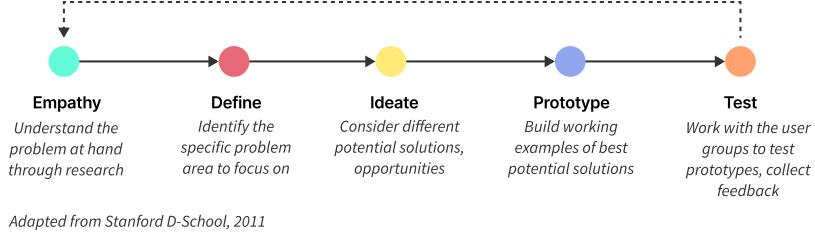
There are multiple ways of considering the design thinking process. One way, as conceptualized by the Stanford D.school, includes five stages:
Where D4H might fit
Between Empathy and Define D4H can be used to provide a foundation of knowledge pertaining to PWLE of heart failure via the HF Communication Best Practices
Between Define and Ideate D4H’s resource repository can be used to understand the current problem space for patients and other PWLE of chronic illness
Between Ideate and Prototype D4H can be used as a reference for UI/UX best practices, especially
Between Prototype and Test D4H can be used as a reference for UI/UX best practices
Testing and beyond Once a project is completed, D4H can be updated with additional resources to reflect knowledge and learnings gained
2. Double Diamond
Another way of conceptualizing the design thinking process is the Double Diamond method:
Where D4H might fit
Discovery phase D4H can be used to augment primary research about heart failure, and provide an introduction to existing products aimed at a patient audience
Define phase D4H’s resource repository can be used to identify and understand the current problem space
Develop phase D4H can be used as a reference for UI/UX best practices, or platforms to use
Deliver phase D4H can be used to discover useful avenues of dissemination for target audiences, or potential partner organizations
3. Impact-Effort Analysis
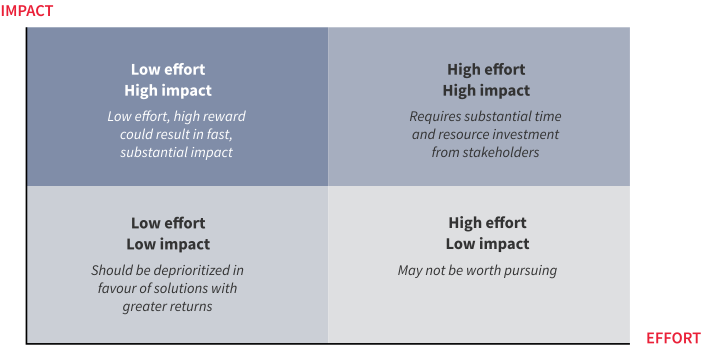
In the initial stages of research and ideation, it is useful to consider the feasibility of a project through an impact-effort matrix. It is ideal for prioritizing tasks and aligning goals to identify key areas of focus, especially as ideas or prototypes are developed and compared.
Where D4H might fit
Use the resource repository and case studies page to examine the process and difficulties for creating similar projects
Gather information (e.g. HF design considerations) that could reduce required effort, increasing project feasibility
Reference design and communication standards for reputable institutions (e.g. American Heart Association; the US Government) to reduce need to develop novel style guidelines/usability research
Design questions for heart failure
The following questions are not unique to heart failure design problems, but should be at the forefront when addressing problems specific to heart failure patients, families, and associated user groups.
How will your design balance generic with bespoke? To what level of will the design be tailored to the individual, vs the entire user group?
Where and how will the design be used? Relying on a user to be online, or to actively use multiple devices, may exclude a significant portion of the intended user group.
How will the design minimize user friction? Related to the previous point: how will the design be used, with minimal error? Innovation is important for overall progress, but conforming to expectations is key to a usable and understandable design.



.svg)